
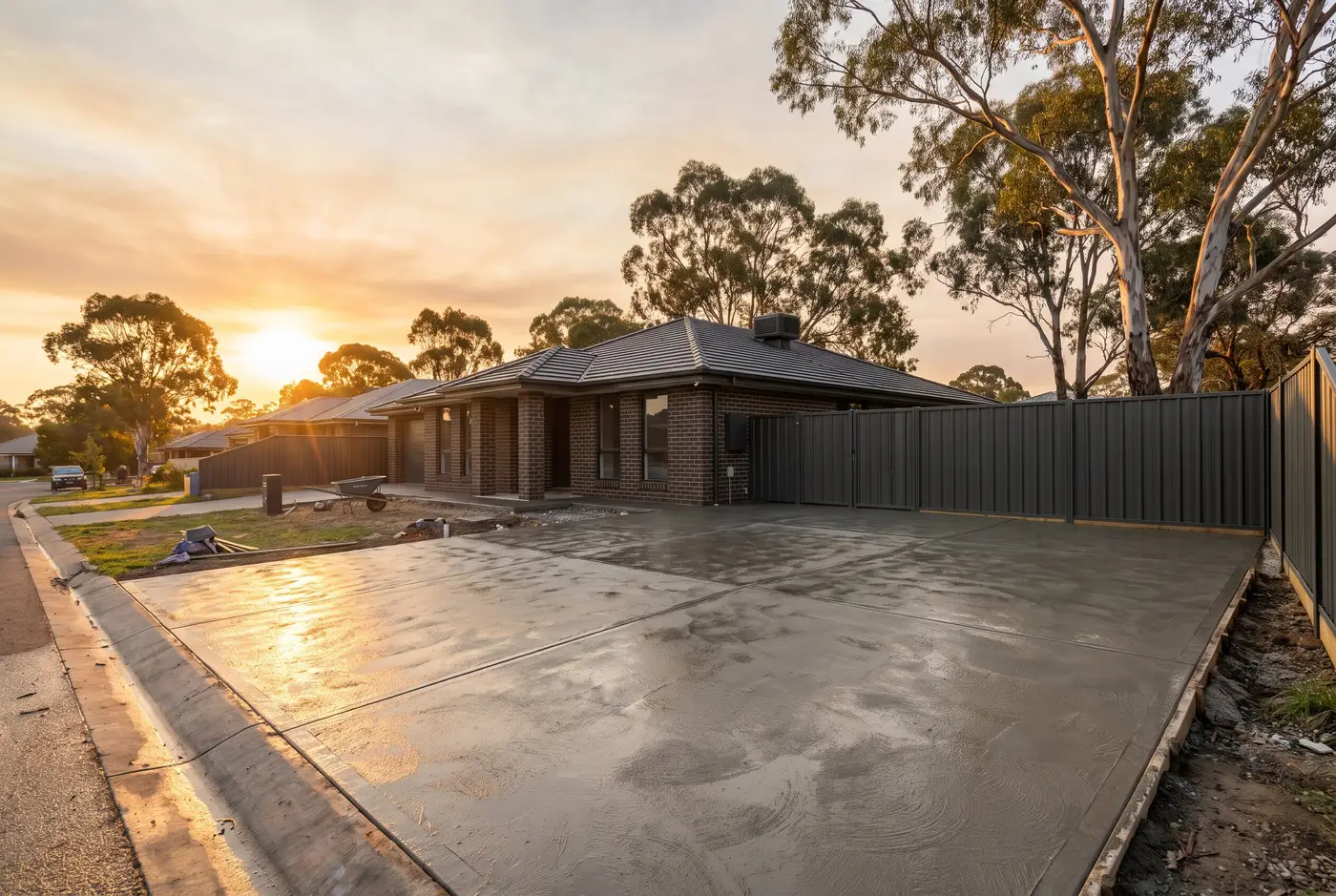
New concrete needs at least seven days of continuous moist curing, starting once it has set, while 28 days is when its specified strength is measured, and the day you can walk or drive on it depends on the mix, the weather and the slab, so your concreter sets it.
Seven days is the number that matters most, and it shows up three times in Australian guidance. Holcim's curing guide says to cure concrete for at least 7 days. Boral's exposed aggregate advice says to maintain moisture for at least seven days. Holcim's DIY laying guide puts stripping the forms at "seven days", once the concrete can carry its load.
Curing starts once the concrete has set, say four to six hours after laying. Twenty-eight days is when its specified strength is measured. When you can walk or drive on it is a separate question. It depends on the mix, the weather and the slab, and your concreter makes that call.
This page gives short answers to the questions people ask most. For the full walk-through of the first four weeks, read our longer guide, How Long Does Concrete Take to Cure? What the First 28 Days Actually Need.
How long is concrete curing time?
Source: Holcim Australia, National Construction Code
Plan on at least a week of active curing, then a wait to day 28 for the slab's rated strength.
- Hours 0 to 6: the concrete is placed, finished and sets. Holcim's guide says curing begins once it has set, say four to six hours, depending on climatic conditions.
- Days 1 to 7: keep the surface moist without a break. Holcim's minimum is at least 7 days.
- Around day 7: formwork comes off once the concrete can support the weight it must bear. The same guide warns not to pry forms off with metal tools.
- Day 28: the point where residential slab strength is specified and tested (more on that below).
Is curing the same as drying?
Source: Holcim Australia
No, and mixing the two up is the most common curing mistake. Concrete does not harden by drying: if it dries out early, hydration stops at the point it loses its moisture, and it cannot reach full strength.
Cement hardens through a chemical reaction with water called hydration. Curing is protecting fresh concrete from evaporation and temperature extremes so that reaction keeps going.
The payoff is large. Holcim puts properly cured concrete at 80 to 100 per cent stronger than concrete that isn't cured at all.
Does concrete need to be kept wet?
| Water-retaining (holds the slab's own water in) | Water-adding (puts water on) |
|---|---|
|
|
| Keep it continuous: alternating wet and dry promotes cracking. Avoid sawdust as a cover. | |
Yes, and it needs to stay wet continuously. Holcim warns that alternating wet and dry promotes cracking. A slab that gets hosed every few days and dries out in between is worse off than one kept steadily damp.
Curing methods fall into two groups:
- Water-retaining: membrane curing compounds or plastic sheeting hold the slab's own water in.
- Water-adding: ponding, spraying or wet hessian put water on.
If your slab is under hessian, sand or canvas, keep it damp. A dry absorptive cover pulls moisture out of the concrete itself. Skip sawdust as a cover, because Holcim says sugars in sap have retarded hardening.
If tiles, paint or a sealer will go on later, ask what curing compound was used. Holcim says membrane compounds must suit the finish or sealer that follows. The National Construction Code's explanatory note makes the same point: chemical curing products may not suit the adhesives used to fix surface finishes.
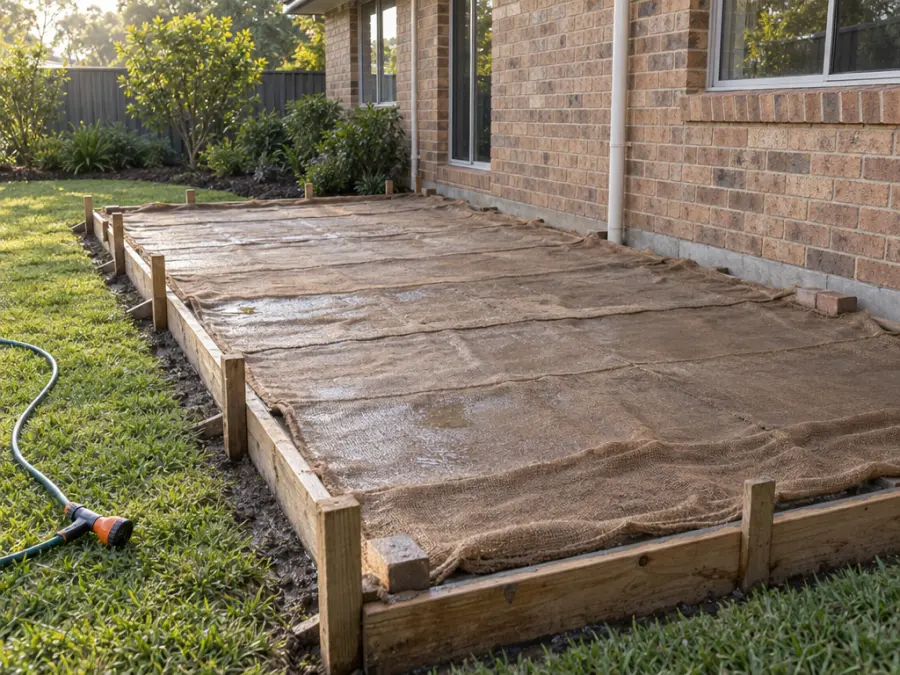
How long before I can walk or drive on new concrete?
Before you walk or drive on it, ask your concreter
Don't load a new slab too early or too abruptly.
There is no single number that holds for every slab, so be wary of anyone who quotes one without looking at the job. The right wait depends on the mix, the weather since the pour, the slab's thickness, and what it has to carry. A 100 mm path that takes foot traffic is a different case from a driveway that takes a loaded ute.
Two pieces of guidance point the same way. Holcim's laying guide ties form removal to when the concrete can support the weight it must bear. Its cold-weather advice says don't load a new slab too early or too abruptly. Your concreter knows what went into the truck and what the weather has done since, so ask them for the date. Then keep cars, trailers and skip bins off until that date.
You may have read about a 7-day no-loading rule or a 32°C pour limit. In the NCC edition that contains them, those are South Australian variations, not NSW rules.
If a driveway is on your list, our concrete driveways page covers the job itself.
What does 28 days mean, and is concrete fully cured then?
National Construction Code 2019 Amendment 1, Volume Two"not less than 20 MPa at 28 days"
Twenty-eight days is a measuring point, not a finish line. In the 2019 edition of the NCC's housing volume, residential slab concrete is specified at not less than 20 MPa at 28 days, known as N20, with a 100 mm nominal slump. Slump measures how wet the mix is. It is not the slab's thickness.
Note that NSW now assesses most new work against NCC 2022 Amendment 2, and NCC 2025 arrives on 1 May 2027. Your certifier or concreter will work to whichever edition applies to your job.
Concrete keeps gaining strength after day 28 as long as moisture remains. But the rated strength assumes the first week went right. The same NCC page says water must not be added to raise slump. Adding water to make concrete easier to place lowers strength and raises cracking and dusting.
What happens to curing on a hot, windy day?
Source: Holcim Australia
Wind is the part people underestimate. Holcim's own worked example is a mild day: air 25°C, humidity 40%, concrete 25°C, wind 20 km/h gives 1.1 kg/m² per hour of evaporation. That is past the 1.0 line where precautions become "almost mandatory". Plastic cracking risk starts at just 0.5 kg/m² per hour.
So a pleasant spring day with a stiff breeze can already put a fresh slab at risk. Holcim notes evaporation can rise to four times when wind goes from still to 15 km/h on a hot day.
The Hunter has already seen real heat this season. On 21 September the temperature reached 35.5°C at Cessnock Airport and Cooranbong, and 35.4°C at Williamtown. Air temperature isn't concrete temperature, but days like that show why the 35°C maximum concrete temperature for field placing under AS 1379 matters here. BOM's outlook also gives most of NSW an over-80% chance of unusually high maximum temperatures for October to December.
On hot days, Holcim's advice is to start curing as soon as possible, wet the sub-grade and forms beforehand, and keep covers wet. Our summer guide, Pouring Concrete in Hot Weather, goes through scheduling a pour around the heat.
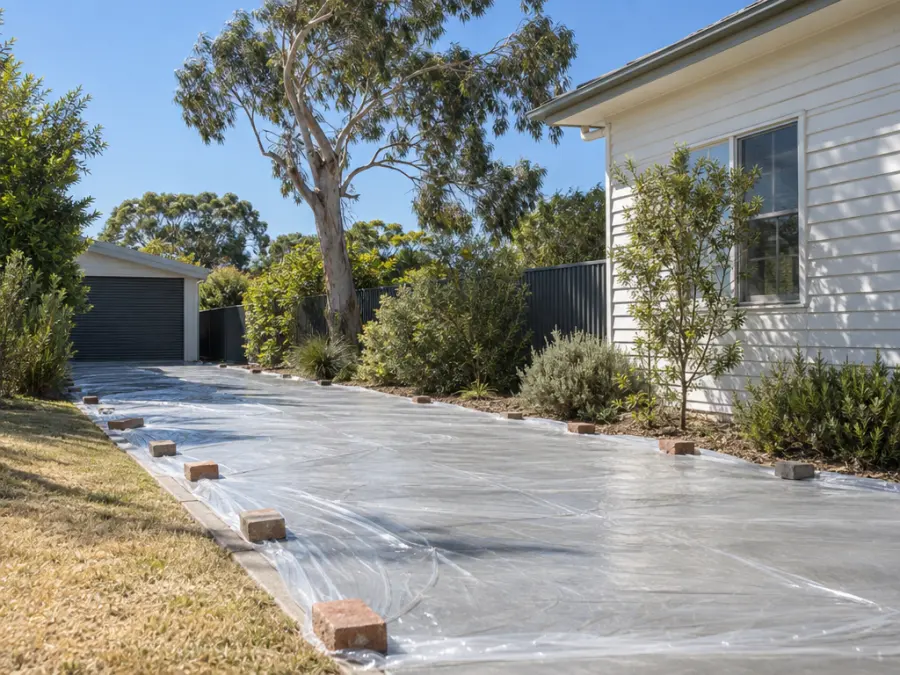
Can you pour concrete in winter?
Source: Holcim Australia
Yes. In most of Newcastle and Lake Macquarie, a winter pour means slower strength gain rather than damage. Holcim says that above 5°C, long-term strength and durability aren't harmed. Where minimum temperatures stay near 5°C, simple covers are enough. For comparison, the ideal curing temperature is 23°C.
The colder end needs more care. Just above 0°C, unprotected concrete gains strength very slowly. Below 0°C, water may freeze and setting virtually stops. Holcim notes that successive frosts can chill the ground in Sydney's western suburbs, and that fly ash in a mix can slow early strength gain in the cold. If your site gets frost, treat it the same way.
In cold weather, Holcim says to leave formwork in longer than the minimum. If insulation is used, it should come off after 5 to 6 days, gradually.
What if it rains while concrete cures?
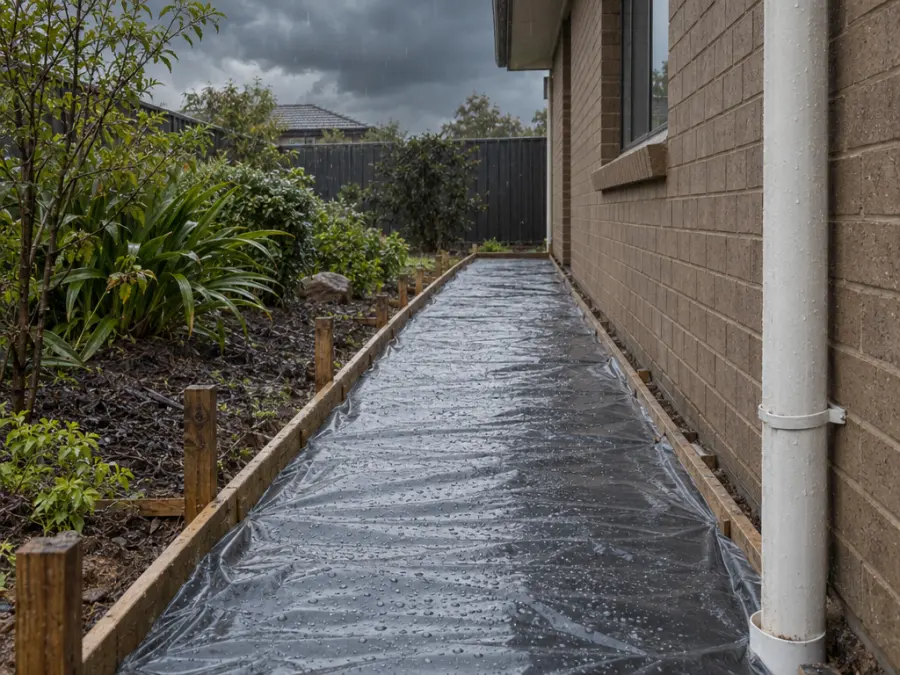
Once the concrete has set, water on the surface is what curing wants. Ponding and spraying are water-adding curing methods in their own right. The real worry is heavy rain before the surface has set and been finished. That is a call your concreter makes on the day, usually by rescheduling or covering the work.
This season may bring both problems. BOM says the wet signal for eastern Australia "emerges later in the outlook period", and that warmer waters increase the potential for high intensity rainfall. A pour in late spring could face heat in the morning and a storm in the afternoon, so keep plastic sheeting handy.
Does a concrete driveway cure differently?
The curing rules are the same, but a driveway usually has a finish and a sealer to think about. For exposed aggregate, Boral says cracking can come from excess water, rapid moisture loss, or poor joint placement. It recommends keeping moisture in for at least seven days, and says the surface is sealed after finishing.
This is where the curing compound matters. Whatever went on in the first week has to suit the sealer that goes on later. Our guide to exposed aggregate driveway finishes covers the finish itself. When an older driveway needs sealing again, see concrete re-sealing and our driveway maintenance tips.
Does curing stop concrete cracking?
Source: Holcim Australia, Boral
Curing lowers the risk. It doesn't remove it. Concrete shrinks as it gains strength, and joints give that shrinkage a planned place to go. Holcim's DIY guide puts contraction joints no more than 2 m apart, cut about 1/4 to 1/3 of the slab's depth.
For a 100 mm slab, that works out to a cut roughly 25 to 33 mm deep. That is our estimate: 100 mm × 1/4 = 25 mm, and 100 mm × 1/3 ≈ 33 mm. The straight lines you see in a new path or driveway are usually these joints doing their job.
The curing habits that help most are the ones above: keep curing continuous, avoid wet-dry cycles, and never add water to the mix. If the slab is for a shed or garage, our guide to installing a garden shed on a concrete slab covers the planning side.
Concrete curing time chart: the numbers in one place
Concrete curing time chart
- Start curingabout 4 to 6 hours after layingHolcim, laying guide
- Cure forat least 7 daysHolcim, curing guide
- Ideal curing temperature23°CHolcim, curing guide
- Properly cured80 to 100 per cent stronger than uncuredHolcim, curing guide
- Plastic cracking riskevaporation above 0.5 kg/m² per hourHolcim, curing guide
- Precautions almost mandatoryabove 1.0 kg/m² per hourHolcim, curing guide
- Max concrete temperature for placing35°C (AS 1379)Holcim, hot weather guide
- Residential slab strength20 MPa at 28 days (NCC 2019 edition)NCC 2019, Volume Two
- Contraction jointsno more than 2 m apartHolcim, laying guide
Source: Holcim Australia, National Construction Code
Every figure in this chart comes from the sources linked above. Keep it on your phone for pour day: start curing at about 4 to 6 hours, cure for at least 7 days, and remember that 28 days is when strength is measured, not the day you can stop caring about the slab.
Planning a pour in Newcastle, Lake Macquarie or the Hunter
The questions on this page are best settled before the truck arrives: when curing starts, what will cover the slab, which curing product suits your finish, and the date your concreter clears it for foot traffic and cars.
Concreters Near Me covers concreting work across Newcastle, Lake Macquarie and the Hunter, from paths to shed and garage slabs. If you have a job coming up, tell us about it through our contact page, and include the slab size, the finish you want, and when you'd like to pour.
Sources
- https://www.holcim.com.au/products-and-services/tools-faqs-and-resources/do-it-yourself-diy/curing-of-concrete-techniques
- https://www.holcim.com.au/resources/diy/laying-concrete
- https://www.holcim.com.au/products-and-services/tools-faqs-and-resources/do-it-yourself-diy/concreting-practice-in-hot-weather
- https://www.holcim.com.au/products-and-services/tools-faqs-and-resources/do-it-yourself-diy/concreting-practice-in-cold-weather
- https://www.boral.com.au/exposed-aggregate-concrete-faqs
- https://ncc.abcb.gov.au/editions/2019-a1/ncc-2019-volume-two-amendment-1/part-32-footings-and-slabs/part-323-concrete-and
- https://www.nsw.gov.au/housing-and-construction/compliance-and-regulation/how-to-comply-national-construction-code
- https://www.bom.gov.au/climate/current/month/nsw/archive/202609.summary.shtml
- https://www.bom.gov.au/climate/ahead/outlooks/archive/20261001-outlook.shtml
- Pictures in this guide are illustrations, not photos of our jobs.