
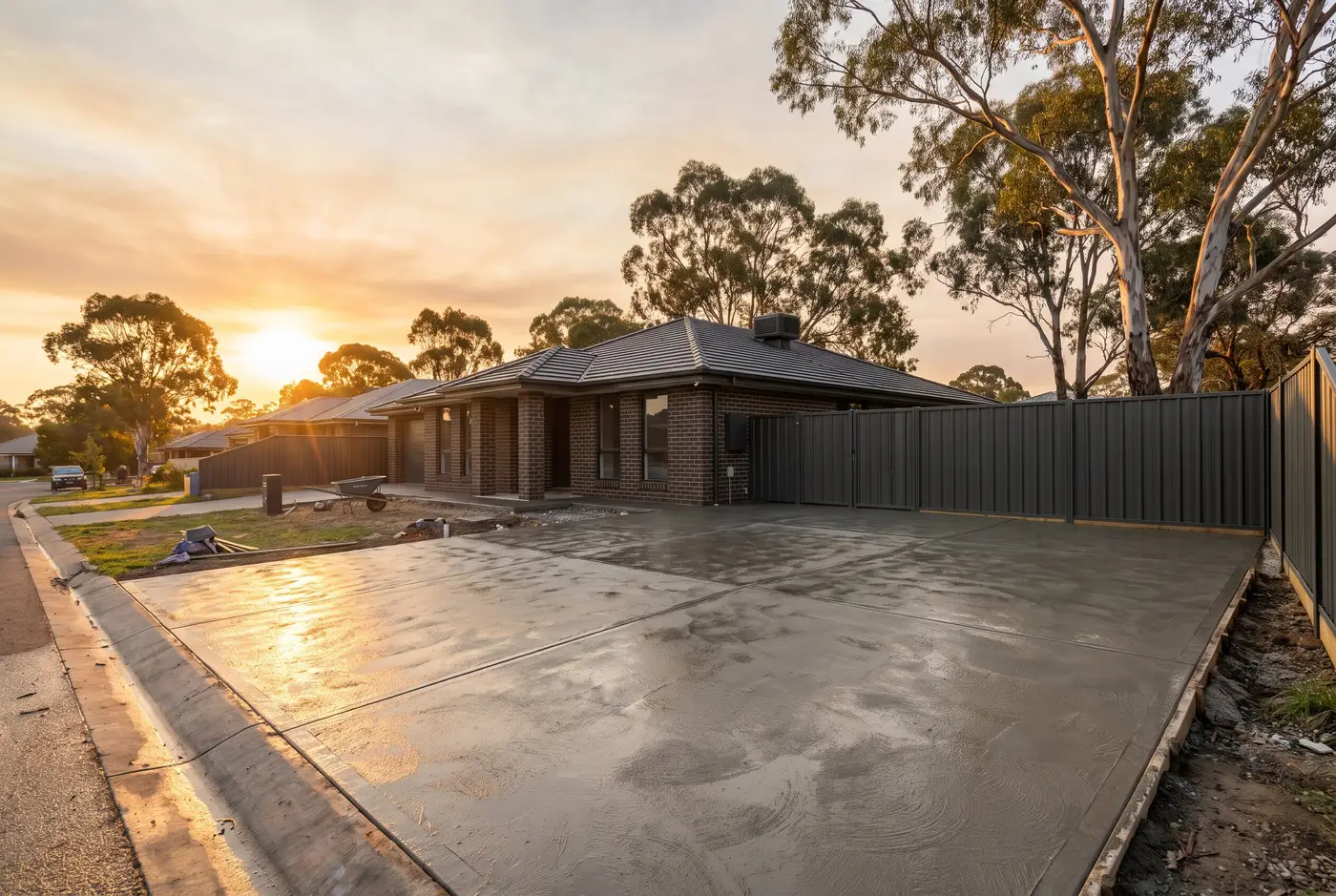
BOM's latest outlook makes warmer-than-average days and nights more likely across most of NSW through to December, so a summer driveway or slab pour needs planning around how fast water leaves the fresh concrete, especially on windy days, and a curing plan that starts straight away and runs at least 7 days.
If you're planning a driveway or slab in the Hunter before Christmas, BOM's outlook issued on 1 October is worth reading for its nights as much as its days. Minimum temperatures are "very likely (greater than 80% chance)" to be above average across almost all of Australia from October to December. For unusually high maximums, the highest chances (over 80%) include most of New South Wales.
In hot weather the main danger to a fresh slab is water leaving it too fast, and wind speeds that up as much as heat does. So the practical answer for a summer pour is twofold. Plan the pour around the day's conditions. Then cure it properly for at least a week.
These are odds, not a forecast. Here at Concreters Near Me, that is how we'd read them: as a reason to plan, not a reason to panic.
What BOM's 1 October outlook says for Australia and NSW
Source: Bureau of Meteorology
The headline is warmth, day and night. BOM says daytime temperatures are likely to be above average for most of Australia, and overnight temperatures are likely to be above average across Australia. For warm nights, the chance of unusually high minimums is "more than 4 times the normal likelihood" across much of the country.
Days lean the same way. Maximum temperatures are likely (60% to over 80% chance) to be above average across most of Australia, with a greater than 50% chance of unusually high maximums across much of the southern two-thirds.
Rain is less settled. Much of eastern Australia has "roughly equal chances of above or below average" rainfall, and the wet signal in the east "emerges later in the outlook period".
BOM also says El Niño is at near-record levels and likely to peak in late spring or summer as a very strong event, while warning that a strong El Niño "does not necessarily mean strong impacts" on Australia.
Bureau of MeteorologyA strong El Niño "does not necessarily mean strong impacts" on Australia.
A very strong El Niño does not guarantee a hot, dry summer: BOM's El Niño explainer, updated 17 September, says "no 2 events are the same" and "it's too early to say what summer will be like". BOM also notes that El Niño's influence on rainfall typically reduces around early summer.
What September already showed in NSW and the Hunter
| Measure | September 2026 |
|---|---|
| Australia, temperature | Second-warmest September on record, +2.71 °C above average |
| NSW, rainfall | 80% below average, 7.1 mm |
| NSW, mean maximum | +4.41 °C above average |
| Williamtown RAAF | 32.8 °C on 5 September, an early-season record for the station |
| Williamtown RAAF | 35.4 °C on 21 September, an early-season record for the station |
Source: Bureau of Meteorology
The season has form. September 2026 was Australia's second-warmest September on record, at +2.71 °C above the 1961 to 1990 average. NSW had its second-warmest and fourth-driest September on record, with rainfall 80% below average, at 7.1 mm, and a mean maximum anomaly of +4.41 °C, the 3rd highest.
Closer to home, Williamtown RAAF recorded 32.8 °C on 5 September and 35.4 °C on 21 September. Both were early-season maximum temperature records for that station.
Those are things that already happened. They are not a forecast for your street in December. They do show that hot pour days can arrive well before summer officially starts.
Pouring concrete in hot weather: what heat and wind do to a fresh slab
Source: Holcim Australia
Concrete needs its water to gain strength. Holcim names the main hot-weather problems as early water loss and early setting through too-rapid drying. Left unplanned, those can show up as reduced strength, crazing or cracking, shrinkage cracks and finishing difficulties.
Wind is the part people underrate. Holcim says evaporation from fresh concrete "will increase to four times when wind velocity rises from zero to only 15km per hour on a hot day". Fifteen kilometres an hour is a breeze you'd barely notice on a walk. On a fresh slab it is a drying machine.
Source: Holcim Australia
You may hear 35°C mentioned. Holcim notes that 35°C is the maximum concrete temperature for field placing allowed under AS1379. That is the temperature of the concrete itself. It is not an air temperature for calling a pour off, so a forecast top of 35 is not, on its own, a yes or a no.
How fast is too fast: the evaporation rates that signal trouble
Source: Holcim Australia
Evaporation from fresh concrete is measured in kilograms of water per square metre per hour. Holcim puts the warning lines here: plastic cracking trouble is "potentially in the making" above 0.5 kg/m² per hour, and precautions are "almost mandatory" above 1.0 kg/m² per hour.
The worked example is the eye-opener. Air at 25°C, humidity at 40%, concrete at 25°C and wind at 20 km/h gives 1.1 kg/m² per hour. That is past the "almost mandatory" line on a day most of us would call pleasant. The breeze, not the heat, is what pushed that example over the line.
What to ask your concreter before a summer pour
Before a summer pour, ask about
Source: Holcim Australia
You don't need to run the numbers yourself. You do want to know there is a plan. These are questions worth raising, drawn from Holcim's hot-weather precautions.
Timing. What time will the pour start? In extreme heat, Holcim suggests it may be wise to start in the afternoon, so the work runs into the cooler evening.
The ground. Will the sub-grade and forms be moistened first? Holcim wants the sub-grade "damp, but not muddy", so dry ground doesn't draw water out from underneath.
The order. Is the delivery sized to the crew and the day? Holcim's advice is to avoid delay in placing, and don't order more than can be finished and covered.
Shade. Will the concrete be shaded, with wet coverings until finishing?
Workability. Adding water on site to keep concrete workable in heat is not a harmless fix, because excess water lowers strength, raises shrinkage and cracking, and can cause dusting and scaling. Holcim says better workability and longer setting times are best achieved with chemical admixtures specified by AS 1478, which mostly must be added at the plant. That makes it a conversation for before the truck is booked, not on the day.
Curing. When does curing start, and how long does it run? The short answer you are listening for is "straight away" and "at least 7 days", which the next section covers.
How to cure concrete in hot weather
Source: Holcim Australia
Curing is where summer slabs are won or lost. Holcim says to start curing as soon as possible and to cure for at least 7 days. The ideal curing temperature is 23°C, and Holcim means the concrete's own temperature, which is why shade and cover matter on a hot day.
Here is why it matters. If concrete dries out in hot weather, hydration "stops right at the point where the concrete loses its moisture". And properly cured concrete is 80 to 100% stronger than concrete not cured at all. Holcim adds that properly cured surfaces wear well and crack less from drying shrinkage.
| Curing method | What to watch |
|---|---|
| Wet hessian or sand | Keep it constantly damp, because wetting and drying in turns can cause cracking. |
| Plastic sheeting | A listed curing method that can double as storm cover. |
| Ponding or misting | A listed curing method. |
| Membrane compound | White compounds reflect sun and cut surface temperature, and it must suit any finish you intend to apply later. |
Source: Holcim Australia
Holcim lists the options: wet hessian or sand, plastic sheeting, ponding or misting, or a membrane compound. Each has a catch in summer.
- Wet hessian or sand must stay wet. Absorptive covers must be kept constantly damp, because alternate wetting and drying can cause cracking. A cover that dries by lunchtime and gets hosed at dinner is working against you.
- Sawdust is not advisable.
- White curing compounds reflect sun and reduce surface temperature, and their colour fades after a few days.
- Holcim says the compound must suit any finish you intend to apply later. If you plan to seal later, say so up front. Our concrete re-sealing page covers that side of the job.
One more caution: Holcim says to avoid big temperature differences between the concrete and its curing environment, to prevent thermal shock cracking. Steady beats dramatic.
For what happens after the first week, including when you can walk or drive on the slab, see how long concrete takes to cure.
Heat and storms in the same season
A summer pour can face a hot morning and a downpour by late afternoon. BOM notes that warmer seas, forecast mainly to Australia's west, can enhance atmospheric moisture, "increasing potential for high intensity rainfall", and its wet signal for the east "emerges later in the outlook period". Its El Niño explainer adds that a warming climate increases the likelihood of hotter conditions, heatwaves, fire weather and heavy rainfall.
So add one more question to your list: what cover is on site if a storm rolls in before the surface has firmed up? Plastic sheeting is already one of Holcim's curing methods, so it is worth asking whether it will be on site anyway.
Our piece on what drives the cost of a concrete driveway explains where curing and timing fit.
Can you stop concrete cracking in hot weather?
Source: Holcim Australia
Honestly, no precaution removes the risk. What the steps above do is shift the odds. A damp sub-grade, shade, a sensible order size, no water added on site, and curing that starts at once and runs at least 7 days all work on the same problem: keeping water in the concrete long enough for it to gain strength.
The season's odds favour warmth. The slab's needs don't change. Plan for the conditions on the day, not the average.
Planning a summer pour with Concreters Near Me
Concreters Near Me covers concreting across Newcastle, Lake Macquarie and the Hunter, from driveways and pathways to shed and garage slabs and pool surrounds.
If a pour is on your list for the warmer months, your next step is simple. Tell us what you're planning and roughly when through our contact page, and bring the questions above to the conversation.
Sources
- https://www.bom.gov.au/climate/ahead/outlooks/archive/20261001-outlook.shtml
- https://www.bom.gov.au/news-and-media/el-nino-what-it-means-for-australias-climate
- https://www.bom.gov.au/climate/current/month/aus/summary.shtml
- https://www.holcim.com.au/products-and-services/tools-faqs-and-resources/do-it-yourself-diy/concreting-practice-in-hot-weather
- https://www.holcim.com.au/products-and-services/tools-faqs-and-resources/do-it-yourself-diy/curing-of-concrete-techniques
- Pictures in this guide are illustrations, not photos of our jobs.