
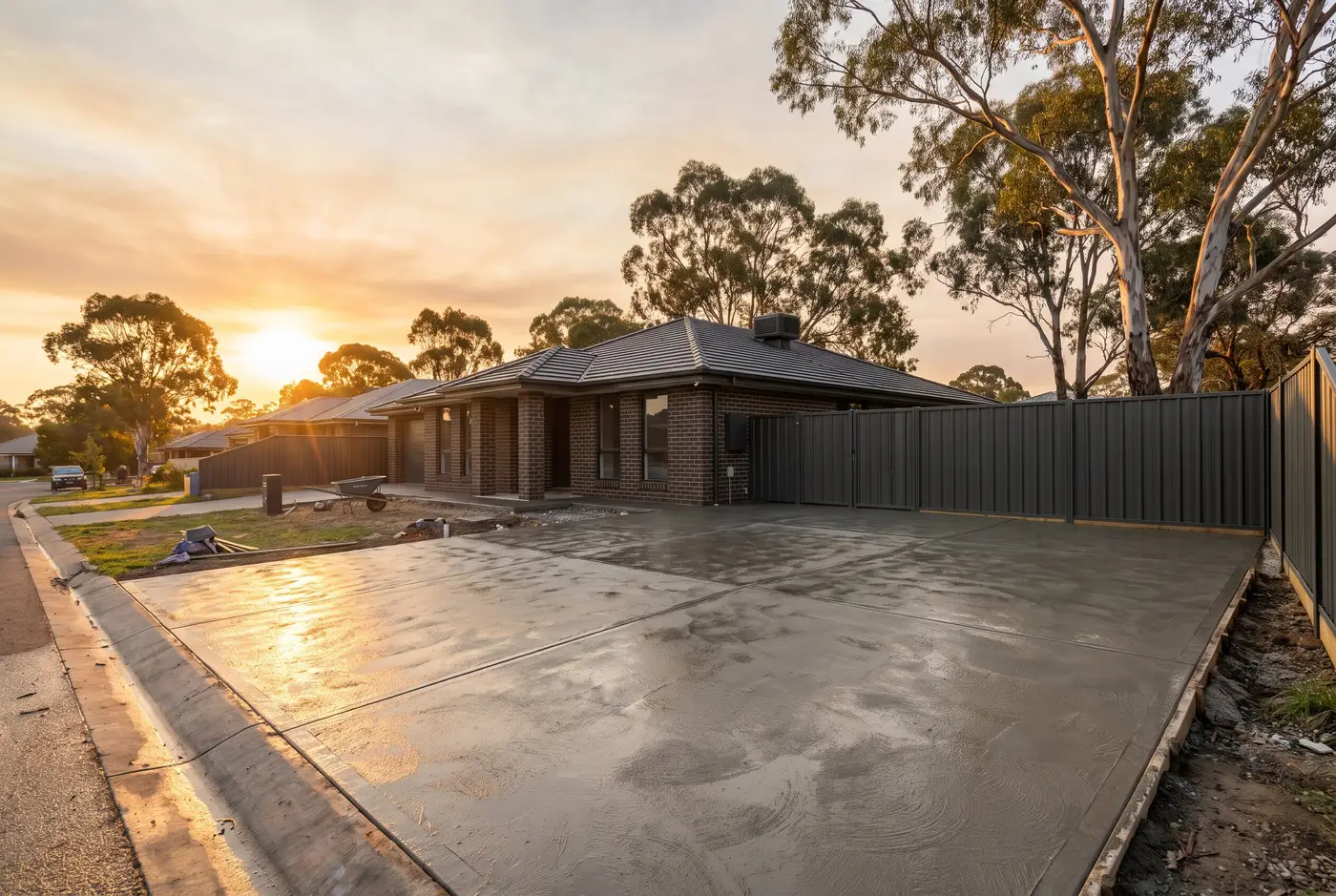
A new slab needs at least seven days of unbroken curing, and its strength is judged at 28 days, so what happens in that first week matters more than how hard the surface feels.
Plan on at least seven days of curing before you treat a new slab as finished. Its strength is judged at 28 days. That's the short answer. The more useful one is this: what happens in those first seven days sets how much of that strength the slab ever reaches, and a slab that feels hard on day two can still be losing ground.
The short answer: seven days of curing, 28 days to design strength
How we worked this out: the seven-day curing band and the 23°C ideal curing temperature come from Holcim Australia, Curing of concrete techniques. The 28-day benchmark of 20 MPa for standard N20 residential slabs comes from the National Construction Code 2019 Volume Two, Part 3.2.3 Concrete and reinforcing. Days are marked, not hours.
Holcim Australia's curing guidance puts it plainly: "Cure concrete for at least 7 days," starting as soon as possible after the concrete is placed. The same guidance gives the ideal curing temperature as 23°C.
Seven days is the minimum for curing. It is not the point of full strength. For a standard house slab or footing, the National Construction Code measures strength at 28 days, with a minimum of 20 MPa, known as N20 grade.
So there are two dates to keep in your head. Day 7 is when the minimum curing period has run its course. Day 28 is the benchmark the concrete is designed to meet.
To put that on a calendar, here is our own working, counting pour day as day 0: a slab poured on Saturday 10 October reaches day 7 on Saturday 17 October and day 28 on Saturday 7 November.
Curing is not the same as drying
How we worked this out: both cross-sections, the seven-day span and the quoted warning come from Holcim Australia, Curing of concrete techniques. The moisture lines are schematic: they show the pattern the guidance describes, not measured readings.
This is the part most people get backwards. A slab that has gone pale and firm looks done, but dry is the opposite of what it needs.
Curing means keeping the concrete moist so the cement can keep reacting with water. Holcim defines it as the protection of fresh concrete from evaporation and temperature extremes that might adversely affect cement hydration. Hydration is the chemical reaction that turns wet mix into a strong slab. It needs water to happen.
Continuity matters as much as moisture. Hosing the slab down in the morning and letting it bake dry by afternoon isn't curing. Holcim warns that alternating wetting and drying promotes cracking. Steady beats generous.
What happens if curing stops early
Holcim Australia, Concreting practice in hot weather"the chemical stops right at the point where the concrete loses its moisture"
Source: Holcim Australia, Concreting practice in hot weather.
Here's why the first week can't be made up later. On hot-weather pours, Holcim explains that if curing concrete dries out, the hydration reaction stops right at the point where the concrete loses its moisture.
Read that as a one-way door. Moisture lost in the early days is strength that never forms. A hose-down on day five doesn't restart what stopped on day two. That's why Holcim advises starting curing immediately and keeping a "weather eye" on conditions.
In practical terms, a slab that dried out early is a weaker slab than it was designed to be. It is also more prone to cracking, especially at the surface you walk and drive on.
So when can you walk or drive on it?
Ask before pour day
Sources: Holcim Australia, Curing of concrete techniques and Holcim Australia, Concreting practice in hot weather. Tick the boxes as you get each answer; nothing is recorded or sent anywhere.
The honest answer is that the Australian manufacturer guidance we rely on gives a curing window, not a stopwatch. We haven't found a manufacturer or standards source that puts a verified hour on "safe to walk" or "safe to drive". We won't invent one.
What the sources do support is enough to plan around:
- The first seven days are for curing. Anything that interrupts it, like pulling covers back to walk across or letting the surface dry out between waterings, works against the slab.
- Strength is still building after day 7. The design benchmark sits at 28 days, not at the end of curing.
- Conditions change the picture. Heat and drying wind make it harder to keep moisture in, which is why curing needs to start straight away in hot weather.
Our advice at Concreters Near Me: keep traffic off during the curing window, and keep the car off longest. Then ask whoever poured the slab when it's ready for feet and when it's ready for wheels. The right answer depends on that mix and that week's weather, and they are the person who knows both. Use the checklist above to get those answers before pour day, not after.
What the 28-day number means for a house slab
| What the building code sets for standard residential footings and slabs | Figure |
|---|---|
| Strength at 28 days | not less than 20 MPa (N20 grade) |
| Maximum nominal aggregate size | 20 mm |
| Nominal slump | 100 mm |
| Manufactured to comply with | AS 3600 |
| Placing, compacting and curing | in accordance with good building practice |
The 20 MPa figure isn't a marketing number. It's the floor the building code sets. Standard residential footing and slab concrete must be manufactured to comply with AS 3600, with a 28-day strength of at least 20 MPa, a maximum nominal aggregate size of 20 mm and a nominal slump of 100 mm.
The same clause says the concrete must be placed, compacted and cured in accordance with good building practice. That's the link to everything above. The mix arrives rated to reach its strength. Curing is what lets it get there.
Keeping a slab cured through a warm Hunter spring
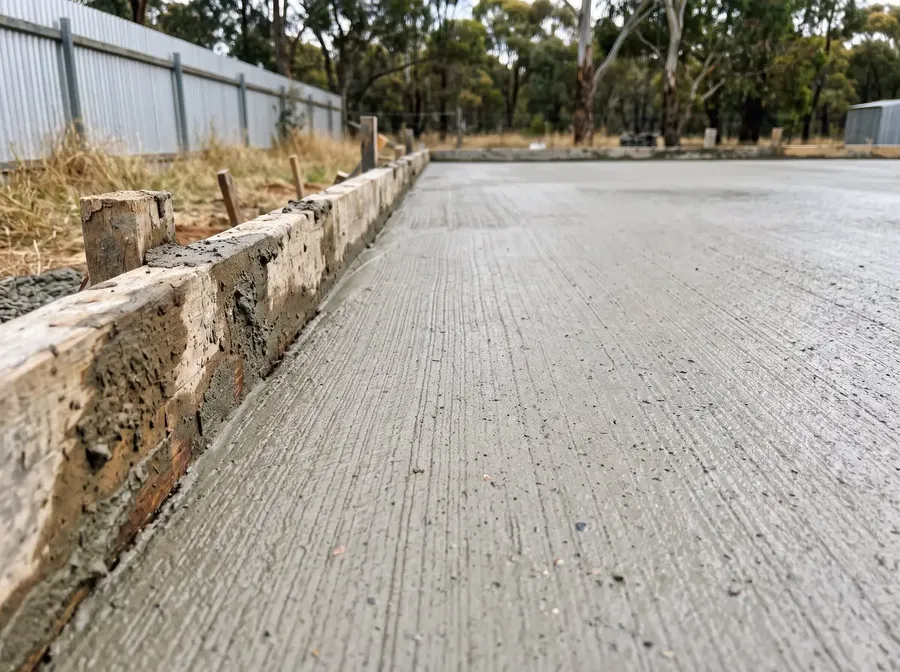
Spring in Newcastle, Lake Macquarie and the wider Hunter brings warmer days and drying winds. That combination pulls moisture out of a fresh slab faster, and it runs well above the ideal 23°C curing temperature on plenty of afternoons. The concrete doesn't get a pass for the weather. The curing plan has to work harder.
Three ways to cure, one rule
The rule under all three: start the moment the slab is finished, and keep it going for at least seven days.
Holcim's curing guidance points to three broad approaches: keeping the surface continuously moist, covering it, or using a curing compound. Each has its place. The rule under all of them is the same: begin the moment the slab is finished, not the next morning, and don't let it lapse inside the first seven days.
In our piece on what drives the cost of a concrete driveway, we flagged weather and timing as a real factor. This is what that looks like on the ground: covers, water, compound and someone keeping an eye on the forecast all week.
Planning a pour? Put curing in the plan
A good slab is decided twice: once when it's poured and again over the week that follows. If you're planning a driveway, path or slab in Newcastle, Lake Macquarie or the Hunter, Concreters Near Me can help you get started. Send the details through the enquiry form, and make "how will it be cured, and when can I use it?" one of the first questions you ask.
Sources
- Holcim Australia, Curing of concrete techniques: https://www.holcim.com.au/products-and-services/tools-faqs-and-resources/do-it-yourself-diy/curing-of-concrete-techniques
- Holcim Australia, Concreting practice in hot weather: https://www.holcim.com.au/products-and-services/tools-faqs-and-resources/do-it-yourself-diy/concreting-practice-in-hot-weather
- Australian Building Codes Board, NCC 2019 Volume Two Amendment 1, Part 3.2.3 Concrete and reinforcing: https://ncc.abcb.gov.au/editions/2019-a1/ncc-2019-volume-two-amendment-1/part-32-footings-and-slabs/part-323-concrete-and
- Pictures in this guide are illustrations, not photos of our jobs.