
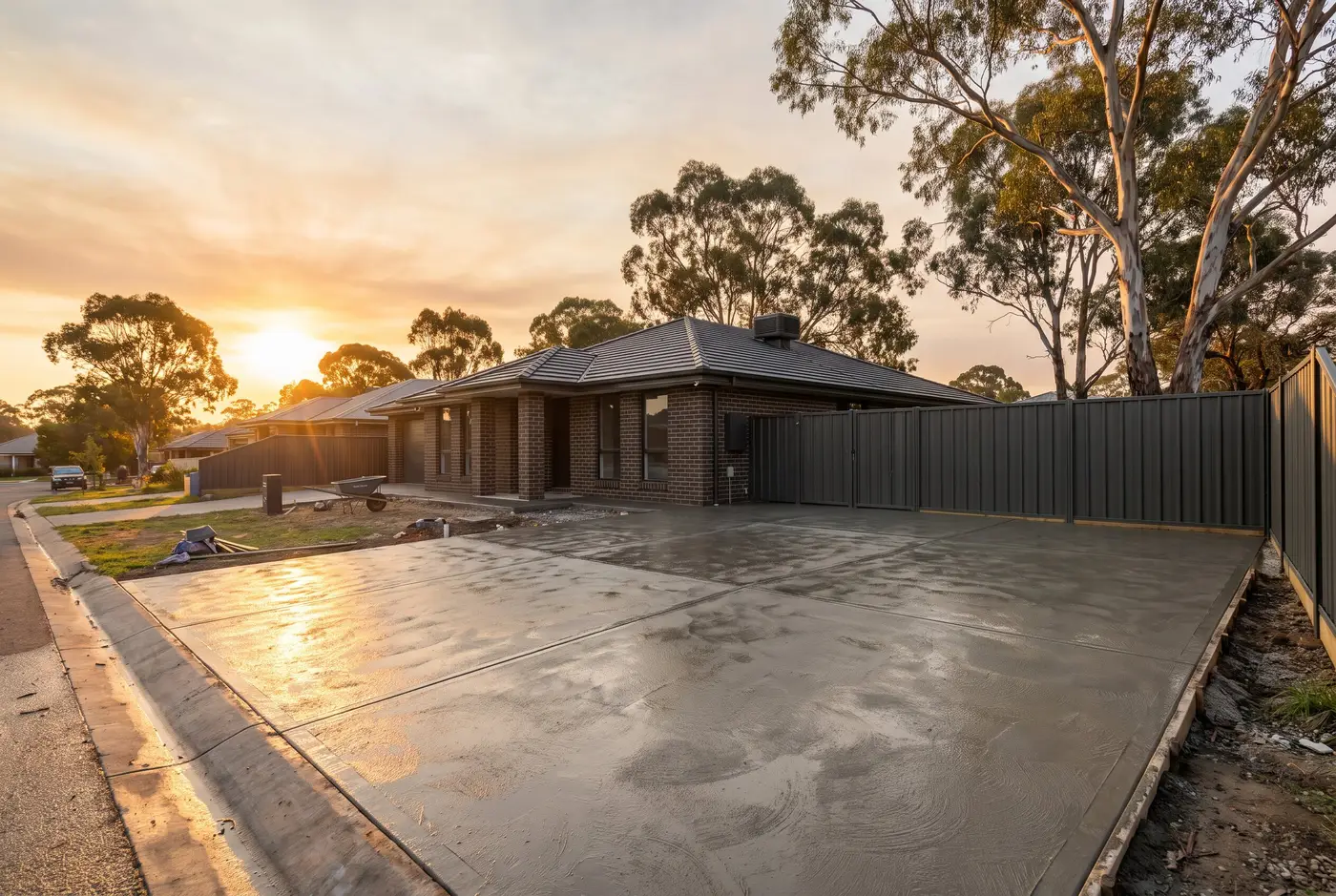
Plastic cracking in a fresh slab comes from its surface losing water too fast, to the air or to a dry base, and a hot, dry nor'wester drives that loss up, so in a Hunter El Niño summer the pours that fare best are timed around the wind, kept off extra water, cured for at least seven days and jointed for the cracks that can still come.
Concrete in the Hunter this summer has a wind problem as much as a heat problem.
At 3 pm on 12 October, Newcastle's Nobbys station recorded 33.8 °C, 20% relative humidity and a north-westerly at 33 km/h. Holcim's worked example for plastic cracking uses gentler weather, 25°C air, 40% humidity, 25°C concrete and a 20 km/h wind. Even so, that example reaches 1.1 kg/m² per hour of evaporation. That is past the 1.0 level above which Holcim calls precautions "almost mandatory".
Set side by side, the Newcastle afternoon was drier (20% humidity against 40%) and windier (33 km/h against 20), and on a hotter day. Our reading, which is not a calculated figure: a slab being finished into that nor'wester would very likely have sat in the zone where Holcim treats precautions as almost mandatory. A weather station doesn't measure the concrete's own temperature, which the example also uses, so read that as a direction rather than a number.
Two days later, the same station recorded a top of just 17.0 °C and 21.4 mm of rain. That swing is the summer to plan for. BOM's mid-October outlook makes above-average November to January maximums very likely (greater than 80% chance) across much of Australia, and leans wetter than average for much of the country too.
Concreters Near Me's advice for a Hunter slab this summer comes in three parts. Plan the pour around the wind, not just the heat. Have a plan ready for a storm. Then cure the slab as if the next day could bring either.
How did Newcastle's hot, windy afternoon compare with Holcim's cracking example?
| Holcim worked example | Newcastle (Nobbys), 12 October 2026, 3 pm | |
|---|---|---|
| Air temperature | 25°C | 33.8 °C |
| Relative humidity | 40% | 20% |
| Wind | 20 km/h | NW 33 km/h (day's peak gust 52 km/h) |
| Concrete temperature | 25°C | weather station readings only |
| Evaporation rate | 1.1 kg/m² per hour |
Sources: Holcim, Bureau of Meteorology
Evaporation rate is the amount of water leaving each square metre of fresh concrete surface every hour. Holcim, a cement and concrete supplier, sets out two lines in its manufacturer guidance. Above 0.5 kg/m² per hour, plastic cracking is "potentially in the making". Above 1.0, precautions are almost mandatory.
Evaporation rate from fresh concrete, kg/m² per hour
- above 0.5: plastic cracking potentially in the making
- above 1.0: precautions almost mandatory
- Holcim worked example: 25°C air, 40% RH, 25°C concrete, 20 km/h wind
Source: Holcim
The thermometer alone won't tell you where a day sits on that scale. Holcim's own example crosses the upper line at a mild 25°C, because the humidity is low and there is a breeze. Wind is the multiplier. On a hot day, evaporation rises to four times when the wind goes from zero to just 15 km/h.
A Hunter nor'wester regularly blows well above 15 km/h. On 12 October it gusted to 52 km/h.
Is an El Niño summer always hot and dry?
No, and this year shows why.
BOM's outlook issued on 15 October says "A strong El Niño is underway", likely to peak around November to December as a very strong event. The heat signal is firm. There is over a 50% chance of unusually high maximums across much of the country, rising above 70% in parts of NSW. Overnight minimums are very likely above average too.
BOM outlook issued 15 October 2026, November to January
Source: Bureau of Meteorology
The rain signal is softer. BOM says rainfall is likely to be above average across much of Australia, with a 40 to 60% chance of unusually high rainfall in parts of south-eastern Queensland extending to north-eastern NSW. For some areas outside those, it gives roughly equal odds.
The same outlook notes that warmer coastal waters can fuel storms and rain systems.
A strong El Niño does not guarantee a hot, dry summer: ENSO is only one of several factors.
ABC News reported that 2026 is on track to be Australia's wettest El Niño year on record. None of the 27 previous El Niño years since 1900 had above-average winter to spring rainfall, and Sydney took more than 100 mm in a week. The same report found the summer rainfall outlook shows no clear signal for most of Australia, with odds near 50 per cent.
Newcastle (Nobbys), October 2026
- 12 Octmaximum 35.2 °C; at 3 pm 33.8 °C, 20% RH, NW wind 33 km/h, peak gust 52 km/h
- 14 Octmaximum 17.0 °C, 21.4 mm rain
- 22 Oct7.6 mm rain
- 29 OctMonth to 29 Oct: 51.8 mm
Source: Bureau of Meteorology
Newcastle's own October showed both sides. It reached 35.2 °C on the 12th, took 21.4 mm on the 14th and 7.6 mm on the 22nd, and had a month's total of 51.8 mm to the 29th.
For a slab, that means two plans: one for a hot nor'wester, and one for a storm the afternoon after.
What cracks fresh concrete in hot, windy weather?
Holcim: evaporation above 0.5 kg/m² per hour, plastic cracking potentially in the making; above 1.0, precautions almost mandatory
Most cracks appear within 2 to 3 days of placing
Source: Holcim
Water leaving too fast. According to Holcim, the majority of cracks occur within 2 to 3 days of placing. Plastic shrinkage cracks form when fresh concrete loses water quickly in one of two directions: up into the air, or down into a dry sub-grade. Holcim says they are checked by windbreaks, shading and surface treatments.
The weather is only part of the story. Holcim cites an industry survey, which carries no date, that attributed cracking roughly as follows: about 36% to construction and supervision, 27% to design, 21% to ambient conditions and 17% to materials quality.
Even on that rough split, the weather accounts for about a fifth. Most of the rest comes down to how the job is planned and run. That is why the questions you ask before a summer pour matter.
Can you pour concrete in hot weather, and what should you ask first?
Yes, with planning. Our hot-weather pour guide covers the general approach. This summer's swings add a few questions worth asking your concreter.
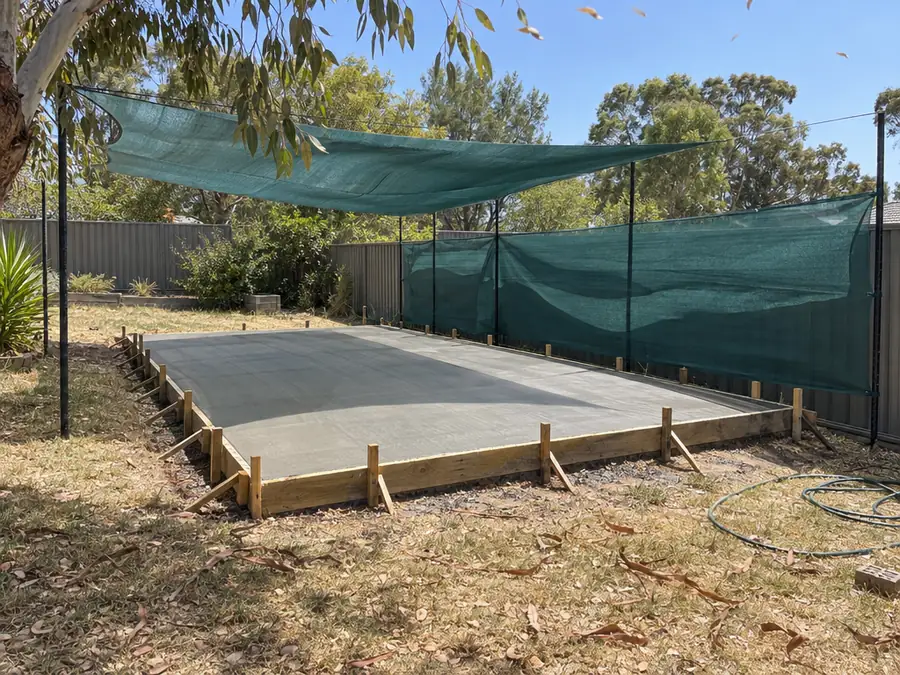
What state will the base be in? Holcim says to wet the sub-grade, steel and timber forms before placing, with the sub-grade "damp, but not muddy". After a run of hot nor'westers, the ground is thirsty and will draw water out of the slab from below. After a day like 14 October, it may already be past damp.
Where will the workability come from? Adding water on site to make the mix easier to place lowers strength, increases bleeding and shrinkage cracking, and can cause dusting and scaling. Workability is better improved with admixtures (AS 1478), which mostly have to be added at the concrete plant. That makes it a decision for ordering day, not pour day.
How big is the order, and how fast will the truck unload? Holcim advises discharging trucks quickly, because prolonged agitation raises concrete temperature. Its other advice is to order no more than can be finished and covered.
What happens if it's very hot on the day? Holcim's suggestion is to shade the concrete, use wet coverings or an aliphatic curing compound until finishing, and uncover only a small section ahead of the finishers. In extreme heat, it says it may be wise to start jobs in the afternoon. Our view: Newcastle's driest, windiest reading on 12 October was taken at 3 pm, so check the forecast wind for the afternoon as well as the temperature.
A note on one number you may hear quoted. Holcim cites 35°C as the maximum concrete temperature for field placing under AS 1379. That is the temperature of the concrete itself, managed by the supplier and the placing crew. It is not a reading off the thermometer in your yard.
Questions to ask before a summer pour
Source: Holcim
How do you cure concrete in hot weather, and does heat make it cure faster?
Heat dries concrete faster, and drying is what stops curing. Holcim gives 23°C as the ideal curing temperature. Its guidance is clear on the risk: if concrete dries out, hydration stops where the moisture is lost.
Cure for at least 7 days. The payoff is large. Holcim says properly cured concrete is 80 to 100% stronger than uncured concrete.
| Curing method | What it does | Holcim's caution |
|---|---|---|
| Wet hessian, sand or canvas | Keeps the surface moist | Must be kept constantly damp or it draws moisture out of the concrete, and alternating wet and dry can crack it |
| White pigmented curing compound | Reflects sun and lowers surface temperature | The colour fades after a few days in sun, and the membrane must be compatible with any later finish |
| Clear curing compound | Forms a membrane | Full coverage is hard to check, and it must be compatible with any later finish |
| Sawdust | Not advisable |
Cure for at least 7 days. Ideal curing temperature 23°C. Avoid large temperature differences between the concrete and its curing environment.
Source: Holcim
Wet hessian, sand or canvas. These covers only work while they stay wet. Holcim warns they must be kept constantly damp, or they draw moisture out of the concrete, and that alternating wet and dry can crack it. On a nor'wester day, that means checking more often than you'd expect. Sawdust is not advisable.
White curing compound. White pigmented compounds reflect sun and reduce surface temperature, and the colour fades after a few days in sun.
Clear curing compound. Clear compounds are hard to check for full coverage.
Whichever compound goes on, the membrane must be compatible with any later applied finish. Raise this early if you plan to seal the concrete later.
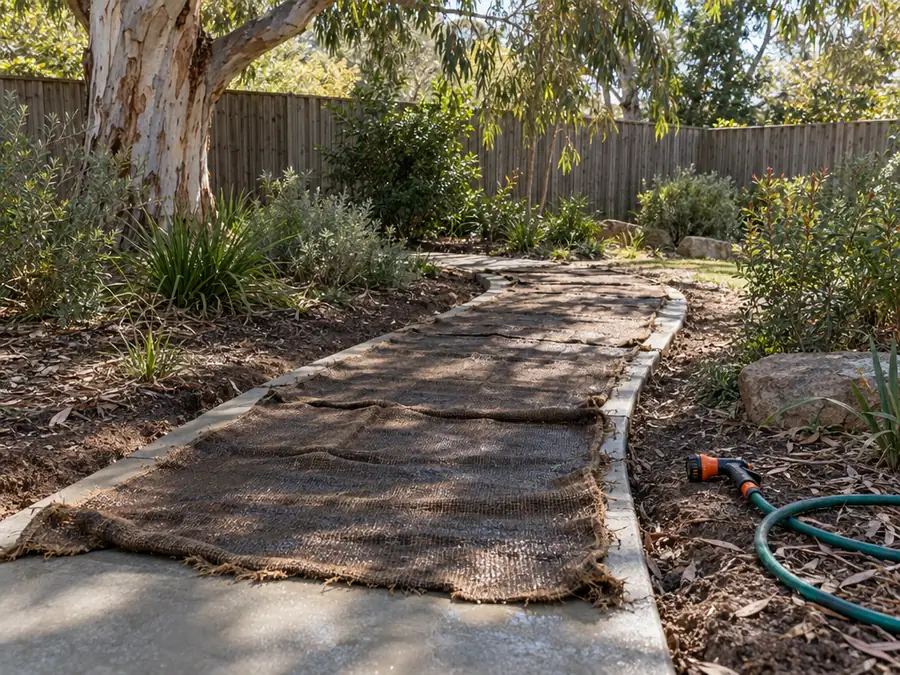
One more caution fits a summer of swings. Holcim advises avoiding large temperature differences between the concrete and its curing environment, which can cause thermal shock cracking.
For when you can walk, drive or hose the slab, see our curing time FAQ. For what happens across the full month, see our guide to the first 28 days.
Why does a new slab have saw cuts, and which cracks are expected?
Because some cracking is part of how concrete behaves. Holcim says shrinkage cracks can be controlled but not always prevented. Joints decide where those cracks go.
- Contraction saw cut
- 10 mm pre-moulded expansion joint
Source: Holcim
Contraction joints. Holcim's guidance is to cut contraction slots one third of the slab thickness, as soon as the concrete resists the saw. The spacing is 5 to 7 m apart in driveways, and ½ to 2 m in paths.
Expansion joints. These are 10 mm pre-moulded joints. They go where paths or driveways meet, and where slabs meet walls or columns.
A fine crack running along the bottom of a saw cut is usually the joint doing its job. A crack wandering across the open slab within the first few days is more likely the drying story above.
For the job itself, see our pages on concrete driveways and concrete pathways. For the years after, see how to maintain a concrete driveway.
The summer pour at a glance
- Outlook
- Nov to Jan above-average maximums greater than 80% chance across much of Australia
- rainfall likely above average across much of Australia, below average in parts of the far north and south-east
- Local swing
- 12 Oct 3 pm 33.8 °C, 20% RH, NW 33 km/h
- 14 Oct max 17.0 °C, 21.4 mm
- Cracking line
- evaporation above 0.5 kg/m² per hour is a risk, above 1.0 precautions almost mandatory
- worked example 1.1
- wind from zero to 15 km/h raises evaporation four times
- Curing
- at least 7 days
- ideal 23°C
- Cracks and joints
- most cracks within 2 to 3 days
- contraction cuts one third of slab thickness, 5 to 7 m apart in driveways, ½ to 2 m in paths
Sources: Bureau of Meteorology, Holcim
Five things carry the whole article: the outlook, the local swing, the cracking line, the curing period and the joints. If you keep one image from this page, keep that one.
Planning a summer slab in the Hunter with Concreters Near Me
Concreters Near Me handles concreting across Newcastle, Lake Macquarie and the Hunter. If a driveway, path, shed slab or pool surround is on your list for the coming months, the useful next step is to describe the site. Say which way it faces, whether it catches the afternoon nor'wester, and how the ground drains after rain.
Send those details through the enquiry form on our contact page. That way the conversation about timing, curing and joints starts with your site, not a generic summer.
Sources
- https://www.bom.gov.au/climate/ahead/outlooks/archive/20261015-outlook.shtml
- https://www.bom.gov.au/climate/dwo/202610/html/IDCJDW2097.202610.shtml
- https://www.abc.net.au/news/2026-10-17/2026-may-become-australias-wettest-el-nino-weather-year/107273884
- https://www.holcim.com.au/products-and-services/tools-faqs-and-resources/do-it-yourself-diy/curing-of-concrete-techniques
- https://www.holcim.com.au/products-and-services/tools-faqs-and-resources/do-it-yourself-diy/concreting-practice-in-hot-weather
- https://www.holcim.com.au/products-and-services/tools-faqs-and-resources/do-it-yourself-diy/cracks-in-concrete
- Pictures in this guide are illustrations, not photos of our jobs.