
Cutting, grinding and drilling concrete makes crystalline silica dust, so before a concreter starts at your place, ask how the dust will be controlled and cleaned up, whether the risk is assessed in writing, whether the masks are fit tested, and to see the licence if the job needs one.
Concrete is not engineered stone, but the dust from cutting it is still crystalline silica. The engineered stone ban does not cover concrete: SafeWork NSW lists concrete and cement products as not engineered stone, yet cutting, grinding or drilling concrete still needs dust controls.
The numbers show why. SafeWork NSW puts concrete and mortar at 25 to 70% crystalline silica. The ban, in place from 1 July 2024, covers engineered stone benchtops, panels and slabs with at least 1% crystalline silica.
So when someone is about to saw joints, grind a surface or drill into a slab at your place, four questions are worth asking. How will the dust be controlled? What is written down? Are the masks fit tested? Can you see the licence? Concreters Near Me sets out each one below, with the rule behind it, so you can ask them on any job in any month.
Does cutting concrete create silica dust?
What's in the dust
Typical crystalline silica content
Engineered stone ban: benchtops, panels and slabs with at least 1% crystalline silica. Concrete and cement products are not engineered stone.
Source: SafeWork NSW
Yes. Crystalline silica is found in sand, stone, concrete and mortar. The fine dust you can breathe in, called respirable crystalline silica, is made by crushing, cutting, drilling, grinding, sawing or polishing those materials. That dust can penetrate deep into the lungs and cause irreversible lung damage.
Concrete sits high on the list. Its 25 to 70% compares with brick at up to 30% and granite at 20 to 45%.
The limit on breathing it at work is tight. Safe Work Australia's workplace exposure standard for respirable crystalline silica is 0.05 mg/m3 as an eight-hour time-weighted average, and it must not be exceeded.
Which parts of a concrete job make the dust?
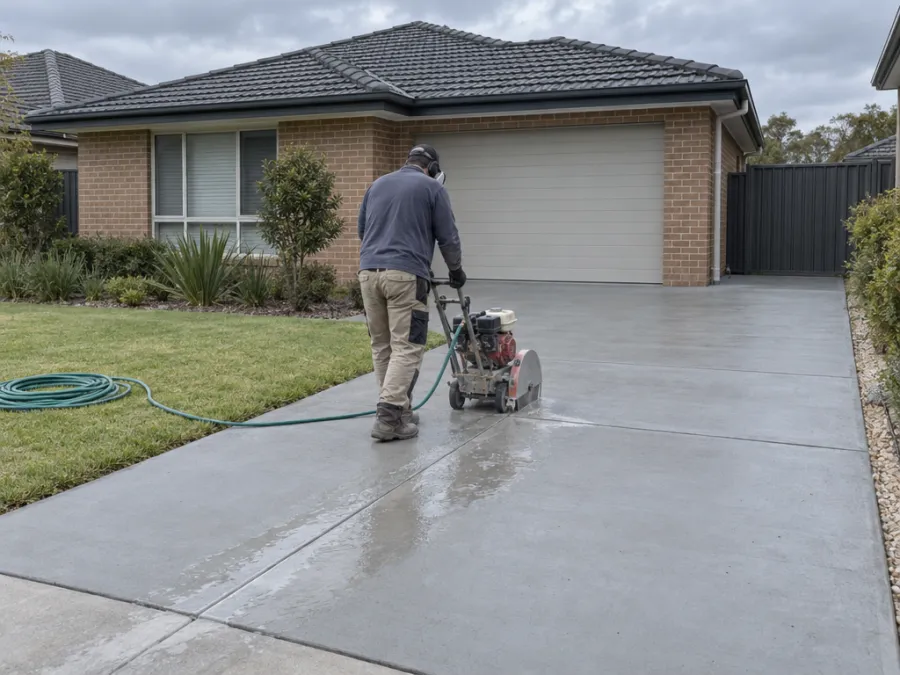
SafeWork NSW gives these as examples of crystalline silica processes:
- brick, concrete or stone cutting
- cutting and laying pavers and surfacing
- excavation, earth moving and drilling
- clean-up by sweeping or compressed-air blowing of silica dust
The last item is the easy one to miss. The dust left on the ground after the saw stops still counts.
On a home job, this usually means sawing control joints in a new driveway, grinding during resurfacing, or cutting out old slab before a pathway goes in.
The regulators name the controls. Safe Work Australia's examples pair local exhaust ventilation or on-tool dust extraction with wet cutting methods, backed by administrative controls and respiratory protective equipment. SafeWork NSW adds isolating dusty areas and regular cleaning to stop dust building up, and says controls must be reviewed regularly.
Dust drifts on the breeze. Isolating the dusty area is one of SafeWork NSW's own controls, so it's a fair question when the job sits beside a play area, a dog run or a neighbour's washing line.
Why does silica dust matter long after the job is done?
A finished slab isn't the hazard. The dust from cutting, grinding or drilling it is.
In its solid form, crystalline silica is not harmful: SafeWork NSW.
October 2026 was National Safe Work Month, which ran under the theme "Safe work is for life". Its second week, 12 to 18 October, was "For health". Its third week, 19 to 25 October, was "For the future".
The harms of breathing it in are serious: silicosis, lung cancer, kidney disease and COPD. Silicosis is irreversible scarring of the lungs.
The damage can also show up late. A single clear health monitoring report doesn't mean a worker won't develop silicosis later, because signs can take time to appear. That's why prevention on the day matters more than any check afterwards.
The finished slab is not the risk. In its solid form, crystalline silica is not harmful. The harm comes when it is cut, drilled, ground or polished.
Safe Work Australia runs the month, but it is not a regulator. The Commonwealth, states and territories regulate and enforce WHS laws. The questions below are worth asking on any job, in any month.
What should I ask a concreter before they start?
Six questions to ask before the saw starts
Sources: Safe Work Australia, SafeWork NSW, NSW Government
These are questions to ask, not a test you have to run. The answers show whether anyone has thought about dust before the saw comes off the trailer.
- How will the dust be controlled when joints are cut or the surface is ground? Water and on-tool extraction are the controls both Safe Work Australia and SafeWork NSW name.
- How will the dusty area be kept clear of family, pets and neighbours? Isolating dusty areas is on the regulator's list of controls.
- How will the dust and slurry be cleaned up? Sweeping or compressed-air blowing of silica dust is itself a listed silica process.
- Is the risk assessed in writing, and if the work is high risk, is there a plan? High-risk processing needs a silica risk control plan, and in construction work a Safe Work Method Statement may be used instead.
- Do the masks meet Australian Standards, and are they fit tested? Workers must be fit tested when they start and every 12 months after that.
- Can I see the licence or certificate? This applies to general concreting valued at more than a set amount in labour and materials (GST included) (checked November 2026). The licence section below explains it.
Who carries the safety duties on a home job?
The business's silica duties, in the order they fall (employer and business duties, not the householder's)
- Before work
- the business assesses in writing whether the processing is high risk, and if unsure, must treat it as high risk
- high-risk processing needs a silica risk control plan, or in construction work a SWMS may be used instead
- masks meet Australian Standards and workers are fit tested at the start
- Within 28 days of a worker starting high-risk silica processing
- the employer notifies the Silica Worker Register (required since 1 October 2025)
- Within 14 days of receiving an air monitoring report above the exposure standard
- notify SafeWork NSW
- Every 12 months
- fit test again
- Ongoing
- controls reviewed regularly
- air monitoring reports kept for 30 years
Source: SafeWork NSW
In the usual case, not you. Under WHS law, a householder is also a PCBU where there is an employment relationship with the worker. PCBU is the WHS term for a duty-holding business. The business doing the work is the PCBU.
Those duties are specific. A business processing a silica-containing material must assess whether the work is high risk and record that in writing. If it's unsure, it must assume the work is high risk.
There is more after the job starts. Since 1 October 2025, employers must notify workers doing high-risk silica processing to the Silica Worker Register within 28 days of starting. Air monitoring results above the exposure standard must go to SafeWork NSW within 14 days of receiving the report, and those reports are kept for 30 years.
None of that is yours to check. Knowing it exists explains why "is it written down?" is a reasonable thing to ask.
Does a concreter need a licence in NSW?
Does this job need a licence?
Typical answer
A driveway resurfacing job where the labour alone is under the set amount, but labour plus materials with GST is over it.
Resurfacing is general concreting and the combined total is over the line, so a licence or certificate is needed.
Penalties: unlicensed work can be fined under the Home Building Act 1989 (checked November 2026). See the NSW Government general concreting page.
Source: NSW Government
In NSW, general concreting work valued at more than a set amount in labour and materials (GST included) (checked November 2026), needs a licence or certificate.
General concreting covers more than pouring a slab. It includes concrete laying, formwork, stamped and exposed aggregate work, concrete repair, resurfacing, and excavation needed before laying concrete. That takes in an exposed aggregate driveway and a resurfacing job as well as a new pour.
That value is not labour only: it counts labour and materials together, including GST (checked November 2026).
The penalties are real. Unlicensed work can be fined under the Home Building Act 1989 (checked November 2026). This comes from the NSW Government's general concreting page, last updated 23 June 2026.
Where can you report unsafe work or ask about dust disposal?
This section is two contacts, so it stays as text.
If you see work that looks unsafe, SafeWork NSW's Speak Up Save Lives app lets you report it, anonymously if you wish.
For advice on disposing of silica dust, SafeWork NSW points you to the NSW EPA on 131 555.
Putting the dust and licence questions into your enquiry
Any month is a good time to ask any of this.
If you're planning a driveway, path, slab or resurfacing job in Newcastle, Lake Macquarie or the Hunter, describe it to Concreters Near Me using the enquiry form on our Contact Us page. Add the six questions above to the same message, so the dust and licence questions are part of the conversation from the first reply.
Sources
- National Safe Work Month, Safe Work Australia
- Workplace exposure standard for respirable crystalline silica, Safe Work Australia
- What are crystalline silica and engineered stone, SafeWork NSW
- Work safely with crystalline silica and engineered stone, SafeWork NSW
- How crystalline silica can be harmful, SafeWork NSW
- Where to get help, SafeWork NSW
- WHS: PCBUs, workers and officers fact sheet, SafeWork NSW
- General concreting work, NSW Government
- Pictures in this guide are illustrations, not photos of our jobs.